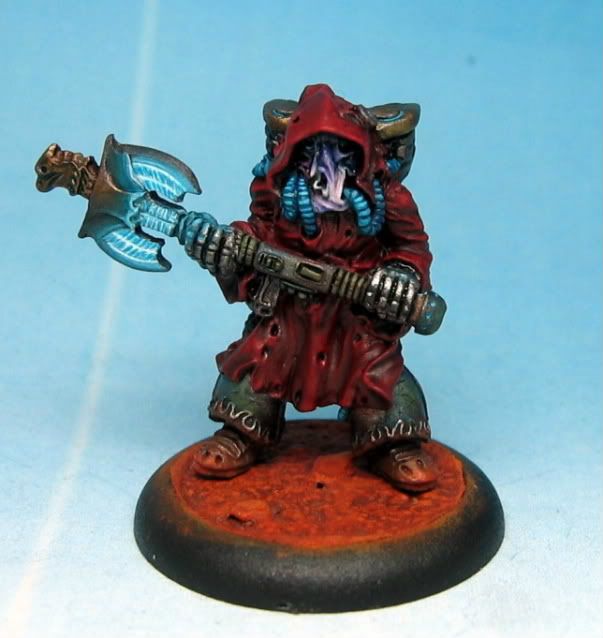
Thursday, December 12, 2013

5 Minute History: Adeptus Mechanicus Organization

Organization

Fabricator-General
Rouge Trader Tech Adept - Artist Unknown

The Fabricator-General of Mars is the leader of the Adeptus Mechanicus, and as the Magos Mechanicus is also the head of its Cult Mechanicus. He also invariably holds a position on the High Lords of Terra.
The Ruling Priesthood
Magos

Magi are the highest ranking Tech-priests. They have mastered a certain aspect of science, of which there are dozens. The rank of Magos accordingly consists of Magos Technicus, Magos Metallurgicus, Magos Alchemys, Magos Physic, Magos Biologis, Magos Genetor, Magos Cybernetica, Magos Explorator etc.
Logis

The Logis is a logistician, analyst, and statistician. His purpose is to predict future trends and make forecasts about expenditure and needs. They are regarded as prophetic figures.
Genetor

A Genetor is a high-ranking Tech-priest specialising in the genetic sciences. They are very common among the Adeptus Mechanicus, and often accompany Imperial forces on exploration missions to new worlds.
Artisan

Artisans (also known as Constructors) design machines, buildings, spacecraft, weapons, and other military hardware. They also control the vast labour forces of Servitors
Magos Fabricator

The Head of the Adeptus Mechanicus and representative for the Agency on Imperial Command, the Magos Fabricator appoints all Adepts within Hive Malton and has overall command of the Adeptus Mechanicus in the entirety of the Hive.
Adept

The local commander for the Adeptus Mechanicus, they command all Adeptus in a particular suburb of the Imperium of Man. They coordinate barricading and supply efforts to ensure that barricades for vital locations remain at their optimum levels, entry points remain free for use, and generators and Vox Casters are properly allocated and powered.
Tech-Priest

More experienced and capable members, Tech-Priests often are quite capable of handling any challenge thrown at them as well as basic medical support and revival services.
Initiate

A fully trained member of the Adeptus Mechanicus and recent graduate of the Collegium Mechanicus, Initiates are the main rank and file who keep the lights on, barricades up, and generators fixed.
Neophyte

New members of the Adeptus, these individuals are still undergoing mandatory training to prepare themselves for work in the field.

Wednesday, December 11, 2013

Gaming: The Importance of Deployment

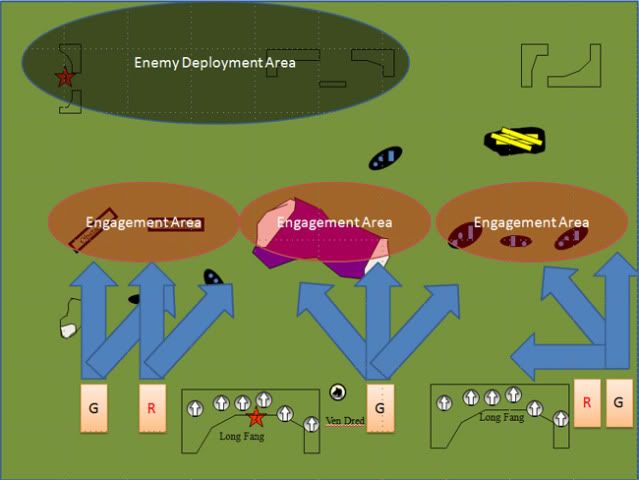
Its the deployment that got me, how many times have you said that? As you can see in the picture I had everything bunched up on the right side and nothing in the middle / left sides. My opponent he ran up a landraider and once I dealt with the terminators he had everything over on the far left and I had to slog my way over to him while he shot me up and delayed me. So instead of deploying like this:


As you can see I bunched up and the terrain funneled my vehicles into lanes that restricted their movement, making it quite easy for my opponent to out maneuver me, heck - I gave him half the board with my shoddy deployment!

now look at this way to deploy:


deploying like this gives me at least three full squads that can converge on any portion of the midfield. Once I have his main effort stopped with three squads of grey hunters I will always have two other squads, one of which carries a rune priest, to get into his backfield. The long fangs pop shots all day long and the dreadnought is centrally placed so he can get wherever he is needed.

Sounds simple but its a huge difference in how you deploy and what you can do for the first two turns.

still practicing_

Tallarn

Monday, July 15, 2013

Banners, Chaplains & Commissions

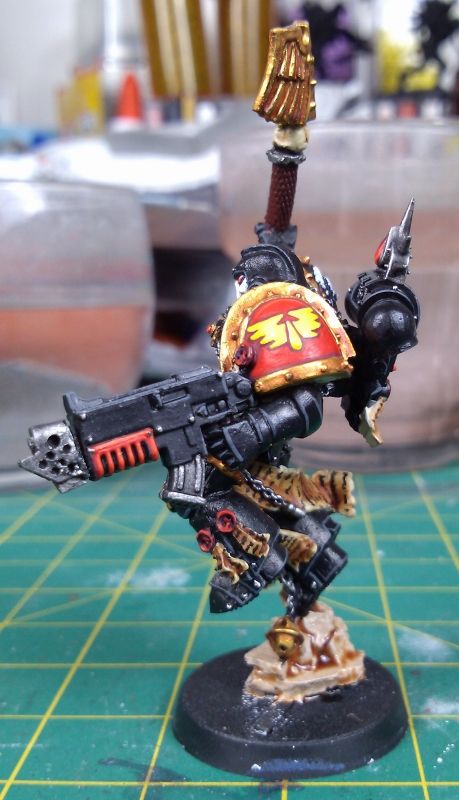
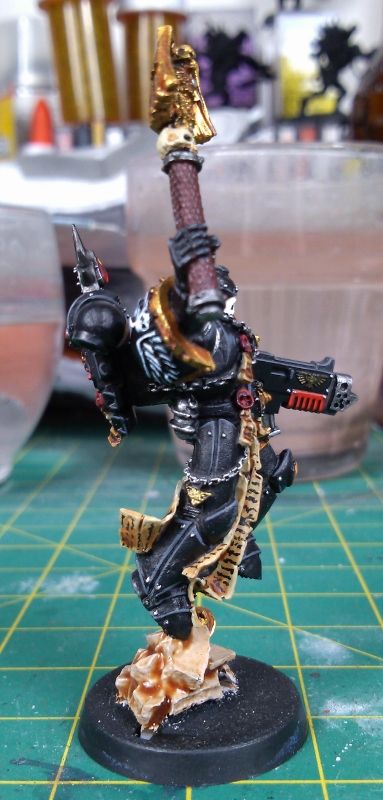
A few months ago JJ over at "How to lose at 40k" put up an offer, make him a banner for his website and he would paint up a mini in trade. After a few emails back and forth I managed to meet his expectations and create a banner design he was happy with. For my mini I asked for a single Death Company Chaplain is exchange. I have been following JJ and his progress over the last year when he started his blog and I thought that I would at least challenge him a bit with the project. Here is the result:


I am putting this gun into a Death Company squad which will all have custom bases, so I let him know that a plain base was fine.


I specifically wanted a Forgeworld type combi-flamer, scratch built (to challenge him a bit). Not only did he get that part perfectly, he free handed the blood angel symbol on the shoulder.


On the scroll work everything is done with minute attention to detail and all the test runs in clear lines.


All the highlights are thin and well done, this is truly an excellent addition to my budding Death Company and I greatly appreciate all the work that went into it. An excellent trade for my work on his banners, and something that a great many people could have taken advantage of!

Now I am not normally one to pimp for other people but JJ has treated me right, and the photo speak for themselves. I would encourage anyone who might be interested in getting some painting done to go over and check out his rates, hes quite reasonable in comparison to some of the other services out there and the quality is just as good (in my ever so humble opinion). His site is here:

Silver Gargoyle Productions

_still practicing

T

Monday, July 8, 2013

Was ist der Boogeyman?


My last article gave rise to some questions about the concept of the boogeyman, and yes – for you readers in England we did add an extra O to the word! So, what is a boogeyman? In its most basic form a boogeyman is simply a shiny object used to attract attention. A perfect, and very recent,  example of a boogeyman either the Wraithknight or the Riptide. Both of these units are intimidating on the table top because of their size in comparison to other models and they are both durable because of their high toughness and wounds. Both of these units are fast on the tabletop and they both pack a fairly lethal arsenal of weapons. So why are both of these very good examples of boogeymen?


Thursday, July 4, 2013

Independence Day 2013: Facts and Stuff

1.) We Are Not a Democracy: People often associate democracy with freedom. We hear this word used all the time by our politicians, by our neighbors, even sometimes by our educators. But the fact is we are not a democracy. We are a republic. Our Founding Fathers deemed this an important distinction to make and discussed the matter quite a bit. In the end, our Founding Fathers claimed that a democracy was both extreme and dangerous for a country as it would most assuredly result in the oppression of the minority by the majority. Take this one example from Founding Father, Elbridge Gerry: "The evils we experience flow from the excess of democracy." And Thomas Jefferson said that democracy should never be practiced outside the limits of a town. Our Founders were very wary of power no matter who had it and thus limited it as much as possible -- this is why we have such a unique system of checks and balances.


2.) Our Founding Fathers Would Not Have Recited the Pledge: Another patriotic tradition that gets a lot of attention, particularly around this time of the year, is the Pledge of Allegiance. The Pledge did not exist during our Founders' lifetimes -- something that is very clear when looking at its text. The Pledge was written over a century after America's founding in 1892. It was also written by a socialist -- Francis Bellamy, whose original text was: "I pledge allegiance to my Flag and the Republic for which it stands, one nation, indivisible, with liberty and justice for all." According to our Founders, the states are not indivisible, but very much the opposite. In fact, when ratifying the U.S. Constitution, some states, such as Virginia among others, specifically declared the right to secede from the Union should they feel it necessary just as an extra precaution to make sure that that state right was understood. Our Founders took their states rights very seriously and considered the U.S. Constitution to be a compact amongst the sovereign states so that any state could secede if it felt the federal government had become oppressive. So, if not with a pledge, how would our Founding Fathers begin meetings and celebrations? The answer: most likely with a prayer. In fact, the very first resolution brought before the First Continental Congress, and immediately passed, was the declaration that they would open every meeting with a prayer.

3.) The Midnight Ride of Paul Revere . . . and 40 others? The mythology of Paul Revere's midnight ride can be traced back to the year 1860 with the writing of that famous poem, "Paul Revere's Ride." Here's what really happened: On April 18, 1775, British troops were ordered to arrest John Hancock and Samuel Adams, both of whom were in Lexington at the time and to seize arms and provisions at Concord. Upon hearing this, Paul Revere and William Dawes set out on horseback -- taking two different routes to Lexington in order to warn Hancock and Adams. Along the way, they warned the towns they passed through of the British invasion. By the morning of April 19 roughly 40 men were out on horseback spreading the news. Revere arrived at Lexington first, followed by Dawes. The two men then headed toward Concord, but were intercepted by British troops. Dawes, though injured, managed to escape, but Revere was captured. He was rescued by American militiamen a short while later. It was during this confrontation between British troops and American militiamen at Concord that the famous shot heard 'round the world was fired.

So this July Fourth, research what you're celebrating and talk about it with your family. Benjamin Franklin said that we have Republic, if we can keep it. Former Congressman and author of the book "In Tune with America: our History in Song," George Nethercutt Jr. put it this way: "The foundation of the freedoms we enjoy as Americans is the U.S. Constitution, the longest surviving constitution of any nation in history. To be civically unaware is to diminish our freedom, but knowing our history makes us all better Americans. Read our nation's Founding documents and they will inspire you."

Monday, June 24, 2013

Rock, Paper, Scissors


In the last month I have managed to get in 5 games against 5 of my friends who all play very different lists with very different armies. Ork Speed Freaks, Necron flyer spam, Tyranid monstrous creature spam, Eldar Jet Bike spam and even an Eldar / Dark Eldar Beast Pack. Now, all of these guys are great players and all of them know their armies each of them have won local and regional tournaments and can regularly be found playing on the top three tables at any event they go to. In full disclosure I will say that I have been testing multiple ideas for a revised army list and not all of these concepts proved useful for what I am trying to do. That being said, my research lead me to a conclusion that I have been ignoring for the better part of 18 months now – the all comer list is dead.


Tuesday, April 9, 2013

How I learned to stop worrying and love the Helldrake


You can’t hunt what you can’t kill. Pretty simple concept really, if your opponent can’t do any damage to your unit – you are free to do what you want. What are we talking about? Why the Helldrake of course! Everyone’s favorite barbeque and vector strike specialist custom made for taking out 3+ armor and almost anything else that gets in his way. Previously I talked about the effect this little guy has had on the game and not over reacting and reminding everyone that there aren’t 3 Helldrakes waiting for you around each corner. Now, let’s talk about some of the tools we have that we can use against this marine killing machine.


Tuesday, April 2, 2013

Helldrake Stage 5: Acceptance


Let start out by saying this is not a rant about how Helldrake is broken, how it ruins the game, or how I crapped my pants and learned to like it when I see that God Forsaken critter on the other side of the table. If you are still anywhere in stages one through four, skip this article and move on to another author who might be in one of the same stages of Denial, Anger, Bargaining or Depression as yourself. Those of us here have already moved on to Acceptance and are quietly plotting the death of our enemies and ways to neutralize them.


Monday, March 4, 2013

40k Tactics - Defining the Battlespace


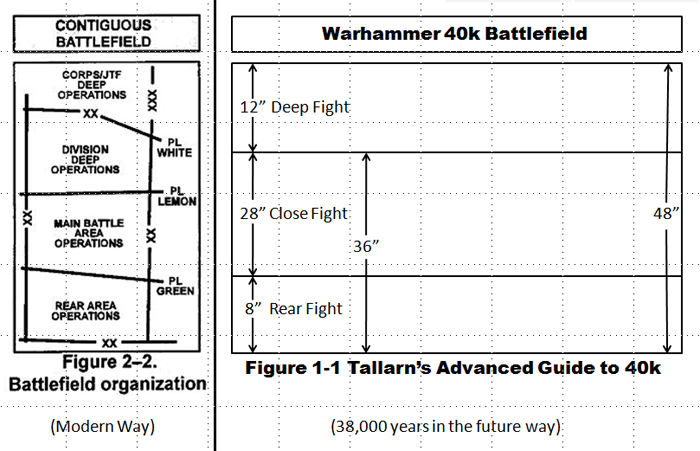
In 1984 NATO adopted a doctrine of battle known of as ‘Air Land Battle’. This doctrine divided the battle space up into a three parts - the Rear Area, the Main Battle Area and the Deep Operations. Generally speaking, different elements in the force were given responsibility for separate areas with clear boundaries on those areas. The areas given to specific units generally fit the capabilities and limitations of the forces assigned to those areas. For example a B-52 would have responsibility for targets in the Deep Operations area because of its ability to deliver large amounts of highly explosive ordnance from the relative safety of high altitude but its inability to actually hold any ground. An Infantry Company or Tank Platoon would be given responsibility in the Main Battle Area due to their relatively short range, compared to the aforementioned B-52, and their ability to take and hold ground, which the B-52 lacks. Artillery with its longer range and high damage potential but relatively low survivability, compared to the Infantry and Tanks, is more suited to the Rear Area where it can support the Main Battle Area with relative safety.


Now, I know that right now you are doing one of two things. You are either:

A)     Wondering who in the hell cares about all this mumbo jumbo.
B)      Already categorizing units in your army based on the above criteria.

Monday, February 25, 2013

Target Priorities in 6th Edition


Recently I got in a game against one of my friends who is preparing a list for a national tournament soon. He told me to bring a no-holds barred list because he wanted a good test for the army he was looking at taking. Happily I obliged with my usual Drop Wolves with a squad of Stern Guard in a pod as well. After the dust settled we totaled up the points and I managed to pull out the victory despite loosing all the Sternguard – opps! We can get into speed bump units, multiple Troop choices or even the merits of Drop Pods some other day. What we are really here to discuss is target priority – because at the end of the game my friend was puzzled with me as to why I was shooting what I was shooting with what I was shooting them with!


Monday, February 11, 2013

Building Better Allies in Blocks

Working through small ally contingents for use with my Space Wolves has led me to thinking about a system of putting together ally forces in a concept of building blocks. The concept of building blocks follows a simple format that creates a single ‘base block’ being your primary detachment. The’ base block’ starts at a bare bones 1,000 point list with no frills and no gimmicks, just wholesale pain at discount prices. To this base block we add detachments of allies that are preformatted into ‘task blocks’ depending on the situation. These ‘task blocks’ fall into three categories: offensive, defensive and operational. In my system ‘task blocks’ only requirement is to be less than 750 points, this gives you a package at the most common point value of 1,750 points.


Monday, January 14, 2013

Drop Pod Defense: 101

I have talked about this at length previously and I find myself once again going back to a foundational principle in order to discuss a proper defensive posture for an aggressive Drop Pod army. The essence of warfare is a violent struggle between two hostile, independent, and irreconcilable wills, each trying to impose itself on the other. War is fundamentally an interactive social process. Clausewitz called it a Zweikampf (literally a “two struggle”) and suggested the image of a pair of wrestlers locked in a hold, each exerting force and counterforce to try to throw the other. War is thus a process of continuous mutual adaptation, of give and take, move and countermove. It is critical to keep in mind that the enemy is not an inanimate object to be acted upon but an independent and animate force with its own objectives and plans. While we try to impose our will on the enemy, he resists us and seeks to impose his own will on us. Appreciating this dynamic interplay between opposing human wills is essential to understanding the fundamental nature of war.


Monday, December 17, 2012

40k Tactics - List Building

Whether you realize it or not everyone has a checklist. When you get up from the table after eating at a restaurant you check your pockets to make sure you have your keys, your phone and your wallet. Everyone does it even if you don’t realize it; your brain is constantly cycling through checklists. It should come as no real surprise that your army lists usually come out with similar tactics and similar qualities, because your brain is automatically using a checklist on you – even in army list building. So what’s in your checklist and how do you figure it out?


Monday, December 10, 2012

Hobby: Priming and Airbrush Trick

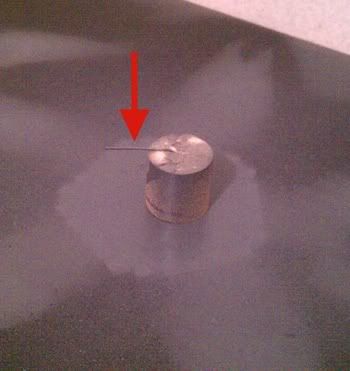
Very simple tricks are almost always the most useful. While painting my mini's before I base them I generally place the pins in the feet and then use corks from wine bottles to hold them in. I just find it easier to paint them with the ability to remove them from their 'holder' before I base them. Another benefit to doing it this way is when using an airbrush or priming.

I always use a flat piece of cardboard to spray against when painting, the last thing painted on this one was drop pods as you can still see the outline. I set my wine cork on the cardboard and run a paper clip through like so:


Monday, November 26, 2012

Warhammer 40k Tactics - Strike Packages 2.0

In my previous discussion I laid out a list of qualities that I think are essential in a solid strike package – durability, mobility, lethality and adaptability. I like to think of these qualities as a starting point that I use when putting together what I refer to as a ‘strike package’. Keeping in mind that in my definition a strike package is a unit that is used to target specific portions of an opponent’s army and eliminate them quickly and efficiently without resorting to using the famous ‘make it fit wrench’ of simply tossing the kitchen sink, or a hammer, at the problem. That being said, strike packages are very much a ‘maneuver warfare’ based concept and people well versed in ‘attrition warfare’ will probably find the concept foreign, and or useless, to them. 

Maneuver Warfare - He's got it!

Monday, November 19, 2012

Warhammer 40k Tactics - Strike Packages 1.0

The strike package – what are they and what do they do? In the ‘real world’ strike packages are put together to deal with threats of a certain level, threats of a level you don’t typically want your standard infantry units to deal with. In the world of Warhammer 40,000 these threats take the form of things like 20 Lootaz dug in behind an Aegis Defense Line. See, I really don’t want a squad of Imperial Guard Veterans or a Squad of Tactical Marines trying to move up and take that out. It’s a specific threat that is difficult to deal with and requires more than the typical ‘square peg – round hole’ solution on the table top, enter the strike package.


Less than optimal Strike Package

Tuesday, October 16, 2012

Space Wolves and the Aegis Defense Line


Where, oh where to begin. Its been a month or so since my last blog post and there are bunches of things floating around in this little skull full of mush that sits atop my neck. Needless to say I won’t be going into them all today. One thing I would like to talk about is fortifications. Now, ill be the first to admit, when I first saw the fortifications I scoffed at them. Who needs these silly little things I asked, pure rubbish. Then I ran head long into the difficulties of trying anything mechanized in 6th edition and contemplated a different solution.

Adapt or Die - its pretty simple!

Monday, September 3, 2012

6th ED: Wolves and Divination


Fair warning for this article: I run a double Rune Priest build and I used to play Everquest. Now that I have gotten that off my chest, let’s go back in time about 12 years. Everquest shaman: great class that made its money making other characters and groups better. Wizards blast, Clerics heal, Druids taxi and Tanks tank – but the Shaman could universally make them all better. Using their buffs that give you bonuses to Health Points, Stamina, Strength and even speed the Shaman could dramatically increase the combat effectiveness of any group or, at higher levels, entire raiding parties with their AOE spells.


Monday, August 27, 2012

6th ED: Wolves and Pods

I love drop pods. The lists that I always enjoyed playing in 5th used 3x Drop Pods and would deliver 1x squad with Rune Priest, Wolf Guard and 8x Grey Hunters along side 2x pods full of a Wolf Guard and 9x Grey Hunters. I found this to be hit and miss (because sometimes that 3rd pod just won’t come on!) and while survivable because of its high numbers – it lacked an ability to run up and punch you in the face. In games against armies using long range supporting fire like Tau and Heavy Marine (thunderfire) armies it did very well. But against mobile armies it could struggle because as Mars always tells me ‘Drop Pods are only fast once’ and every once in awhile my guys would find themselves struggling to keep up with faster armies.


Monday, August 13, 2012

Introduction to Casting Part II

First as a 'public service announcement' the original post in this series was done in way back in February (LINKY) sorry I am getting part two up so late, but hey - there was like stuff going on and stuff! Here we have the assembled tools. You will need a container to mix your resin in, this container (red solo cup) must be DISPOSABLE as there will be hard resin left over from the casting in it. I have cut mine like you see in the picture because I can pour easily and maintain better control of the resin by pouring down that flap sticking up. The Popsicle stick is used to mix the two parts of the resin and in the cups you can see the clear and brown portions of the mix.